MiniMiniature can be programmed in theatres, museums, festivals, libraries, nurseries, preschools, primary schools and other cultural spaces. Its form adapts to different contexts while preserving the essential conditions that define it.
Two versions for two age groups
The 0–3 version lasts about forty minutes and gives greater weight to wordless singing: three of the six songs remain entirely non-verbal. It can welcome up to 25 adult-child pairs or, in educational settings, groups of up to 25 children accompanied according to the host organisation’s practice.
The 4–10 version lasts about fifty minutes. One song remains entirely wordless, while the other five also develop words and objects. Up to 25 children are welcomed within the performance space; in theatres, where the configuration allows it, additional adults may observe from the auditorium.
The space
The layout is developed in dialogue with the host venue. In a theatre, part of the stage or a platform may be used; in an educational or museum setting, a more intimate room may be sufficient.
As an indication, a theatre configuration requires approximately 6 × 6 metres, while in some educational contexts MiniMiniature can also be realised in a space around 3 × 4 metres. Other configurations can be assessed case by case.
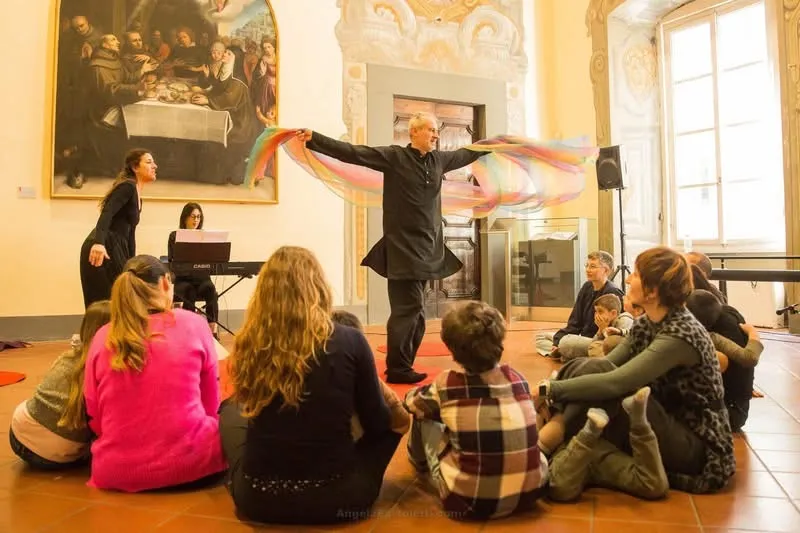
More than size, the spatial relationship matters
What matters is the possibility of gathering the audience close to the performers, ensuring mutual visibility and leaving enough room for the two singers to move between different points of the action. In MiniMiniature, listening also means physically sharing a space.
One, two or three performances in a day
One, two or three performances can be scheduled on the same day. This makes it possible to reach more groups while preserving the intimate scale required for each performance, and can work particularly well for schools, museums, festivals or touring circuits.
An adaptable form with stable principles
Adaptation means rebuilding in each venue the conditions in which the same artistic conception can work: proximity, freedom of movement, visibility, quality of listening and a space in which performers and audience can genuinely be together.
Full technical requirements, setup procedures and financial conditions are defined with the host organisation. The institutional dossier and video documentation are available on the website.