MiniMiniature 4–10 is a live music performance for children, families and schools. Its fundamental structure remains the same: two voices and piano, an audience close to the performers, movement through the space, small objects and a continuous dramaturgy. What changes is the balance between wordless music, text and image.
Six songs, a different balance between music and words
In the 4–10 version, one song remains entirely wordless, while the other five also develop verbal and visual dimensions. Words enter as poetic material within the singing and can bring forth an image, an object, a character or a small situation.
Brief autonomous scenes appear: the sea, snow, a spinning top, a kite, a grain of sand, a palette, a butterfly. They gain presence and then make room for something else.
The boundary between singing and storytelling deliberately remains mobile.
Words that open images
Text temporarily opens a new horizon of listening: something first encountered in its musical form may suddenly meet a figure or a brief story, and the words can then give way once again to singing without text.
The small stories remain essential and concise. A few words can be enough for a situation to emerge and meet a gesture, movement or object. The voice retains rhythm, intonation and musical quality even when it moves closer to storytelling.
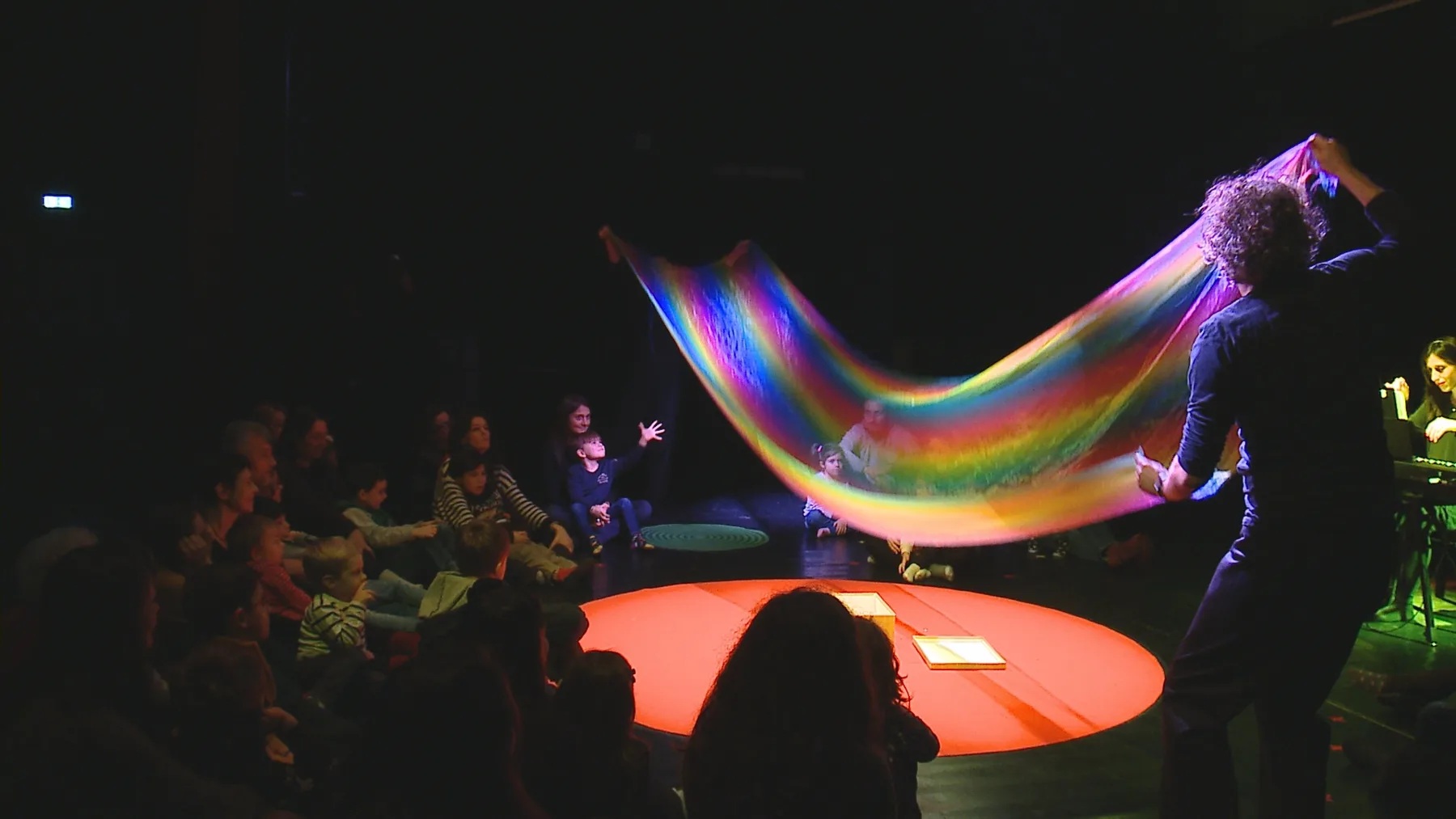
Objects that open the imagination
MiniMiniature uses only a few objects, each closely connected to a particular scene. They appear as temporary presences and offer a point of support for the imagination: a material, a colour or a movement may be enough for a sea, a kite or a butterfly to appear.
The principle is to show just enough for something to emerge, leaving imagination the space to complete it. Objects enter the time of singing and piano; they are opened, moved, folded and finally put away with the same care with which they appeared.
A form for schools, theatres and festivals
The 4–10 version lasts about fifty minutes. Up to 25 children can be welcomed within the performance space; in theatres, where the configuration allows it, additional adults may observe from the auditorium.
The form can inhabit theatres, libraries, festivals, museums and educational spaces. The configuration adapts to each venue, while proximity remains central to the relationship with the audience.