MiniMiniature for the early years is a live music performance for children aged 0–3 and the adults who accompany them. Two voices, piano, movement, small objects, words and silence create an intimate experience in which the audience is close to the performers and relationship belongs to the artistic form itself.
Music before explanation
In the 0–3 version, three of the six songs remain entirely wordless. In the other three, words and objects appear only after the music has first been encountered as music. Purely musical experience therefore retains a particularly strong presence throughout the performance.
Wordless singing places melody, rhythm, timbre, articulation, dynamics and breath at the centre of the experience. Together they create a recognisable form while leaving verbal meaning open. A young child can meet singing through body, movement, gaze and voice, allowing understanding to take shape over time.
To offer and leave room for a response to emerge, recognising that attention can appear in ways that are not immediately legible to an adult.
Child and adult inside the same experience
A very young child experiences MiniMiniature together with the accompanying adult. Child and adult form a shared listening pair: physical closeness, exchanged glances and the way an adult welcomes surprise or waits alongside the child all contribute to the quality of the experience.
MiniMiniature welcomes many forms of response. A child may remain still, move, come closer, move away, watch an object, seek the adult’s body, vocalise or seem momentarily elsewhere. The performers observe what happens and receive each initiative as it is, allowing it to remain individual or to enter spontaneously into the group relationship.
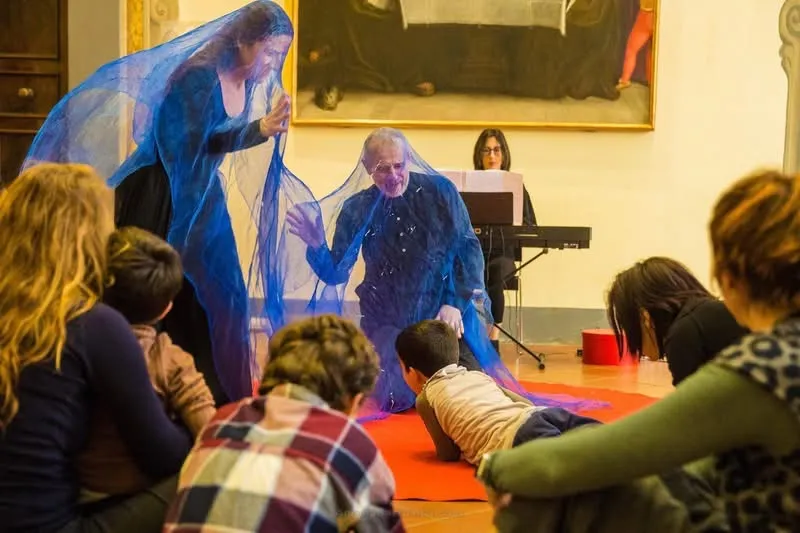
A shared space
The usual distance between performers and audience is reduced. Voices may arrive from nearby and then move elsewhere; the singers cross the space, change direction and meet the audience’s gaze. The piano remains a more stable point within a geography that is constantly shifting.
Proximity lives through an alternation of presence and distance: a performer may approach and then withdraw; a broad movement may be followed by stillness; even the empty space between one gesture and the next becomes perceptible.
Pedagogical knowledge transformed into artistic form
MiniMiniature grows out of many years and many thousands of hours of direct musical practice with very young children in nurseries, preschools and family settings. Edwin E. Gordon’s Music Learning Theory is an important reference: from this experience come the attention to wordless singing, variety of repertoire, movement and the possibility of encountering music before verbal understanding is required.
Within the performance, this knowledge acts as artistic and compositional competence, shaping repertoire, timing, silence, repetition, the way performers approach and the way they wait. Artistic experience remains at the centre, allowing attention, learning and relationship to emerge in different forms and at different times.
Duration and capacity
The 0–3 version lasts about forty minutes. It can welcome up to 25 adult-child pairs or, in educational settings, groups of up to 25 children accompanied according to the host organisation’s practice. One, two or three performances can be scheduled on the same day.