MiniMiniature has a precise dramaturgical structure. The six songs form a continuous arc: each grows from what precedes it and prepares, more or less visibly, what will follow.
The voice: between singing and words
The voice may remain entirely musical, meet words, generate an image and return to singing without those transitions breaking the continuity of the experience. The boundary between singing and storytelling deliberately remains mobile.
Words open images within the music. They may emerge within a song and briefly bring forth the sea, snow, a spinning top, a kite, a grain of sand, a palette or a butterfly. A few words can be enough for a small world to appear.
Dramaturgy begins with arrival
The arrival of children and adults is the first phase of the concert. Voices, performer presence and the way the audience settles into the space gradually carry the experience from arrival into shared musical attention.
From there, an arc of six songs unfolds. What holds the scenes together is above all the time of transformation: a song may change, words may appear, an object may enter, movement may expand or gather inward.
Making a world appear with very little
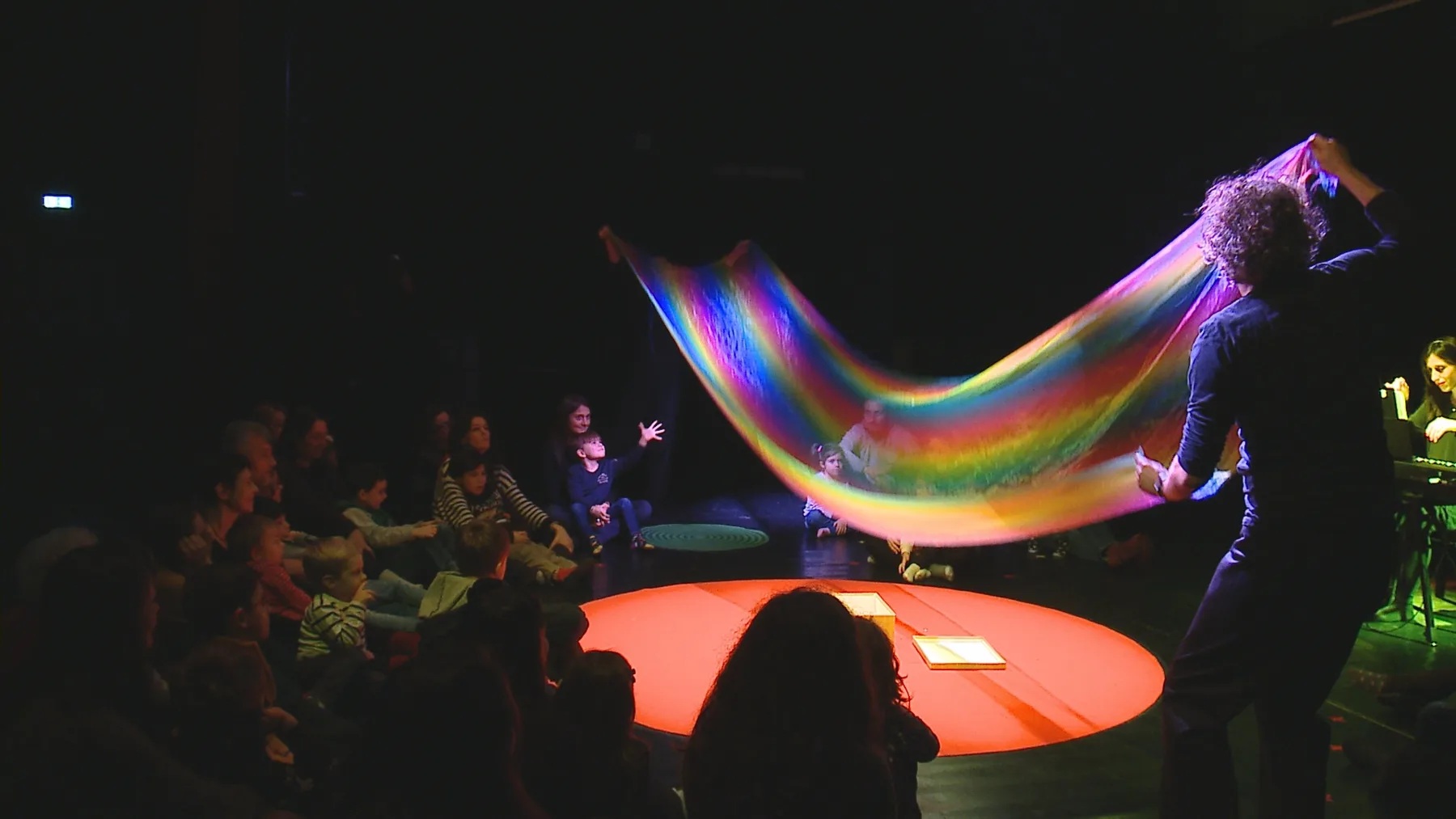
Objects are few, simple and closely connected to individual scenes. They appear as temporary presences, entering the space for the time needed to let an image emerge and then returning it to its simplicity.
MiniMiniature works through suggestion rather than reproduction. A few elements are enough for a sea, a kite, a spinning top or a butterfly to appear. Music, gesture and imagination build together a world that takes shape in the experience of those who listen and watch.
Show just enough for something to appear, leaving imagination the space to complete it.
Transitions are part of the work
An object is found, taken, opened, unfolded or shown; afterwards it is gathered, folded when necessary and put away carefully. The care devoted to its appearance continues through its departure, and the way it is released prepares what follows.
There is also room for improvisation within the structure. Performers can lengthen, shorten or transform passages in response to what is happening. The form remains recognisable and its concrete timing varies from one performance to another.
The ending: allowing the experience to finish
The ending extends beyond the last note of the final song. It is a sequence in which image, gesture, piano, voice and silence gradually withdraw. After the final scene, the performers sit again; movement reduces; what remains is piano, voices and the people present.
The piano repeats a short phrase a few times. Then comes the farewell, sung three times on a descending movement: “ciao, ciao, ciao”. The farewell opens one final shared span of time: after the last note, silence remains.
That silence may last a few seconds or much longer. It carries the resonance of what has just happened and leaves the people in the room in one another’s presence. The image recedes, gesture reduces, a few notes remain, then a farewell, then silence. MiniMiniature ends through progressive subtraction.