Before MiniMiniature there was a daily and continuous musical practice with children. For years, work in nurseries and preschools meant returning to the same groups week after week, bringing different repertoire, singing mainly without words and observing what happened over time.
A practice that precedes the performance
Continuity made it possible to see music become familiar through experience, to recognise very different forms of participation and to observe how deeply body, movement, gaze and voice take part in listening from the very beginning.
Over time, the performers refined above all how to be present, alongside what to offer: how close to come, how long to wait, when to repeat and when to change, how to direct a song to one person while keeping them within the field of the group, and how to receive an unexpected initiative for what it is.
Relationship belongs to the artistic form and is one of the conditions through which the form comes alive.
From educational knowledge to composition
MiniMiniature begins when this experience becomes an artistic question. The process required a genuine act of composition: selecting, removing and transforming. Some songs remained wordless, others met texts and images; the piano acquired an independent role; objects, movements and visual transformations entered the structure.
What could unfold across weeks or months in educational practice now had to find completion within the limited duration of a performance. The earlier experience remains beneath the surface as an ability to read what is happening, to balance presence and distance and to hold a structure that is both flexible and recognisable.
Wordless singing and embodied listening
A significant part of the repertoire consists of wordless songs. This places melody, rhythm, timbre, articulation, dynamics and breath at the centre, while leaving open the field of images and meanings that may emerge through listening.
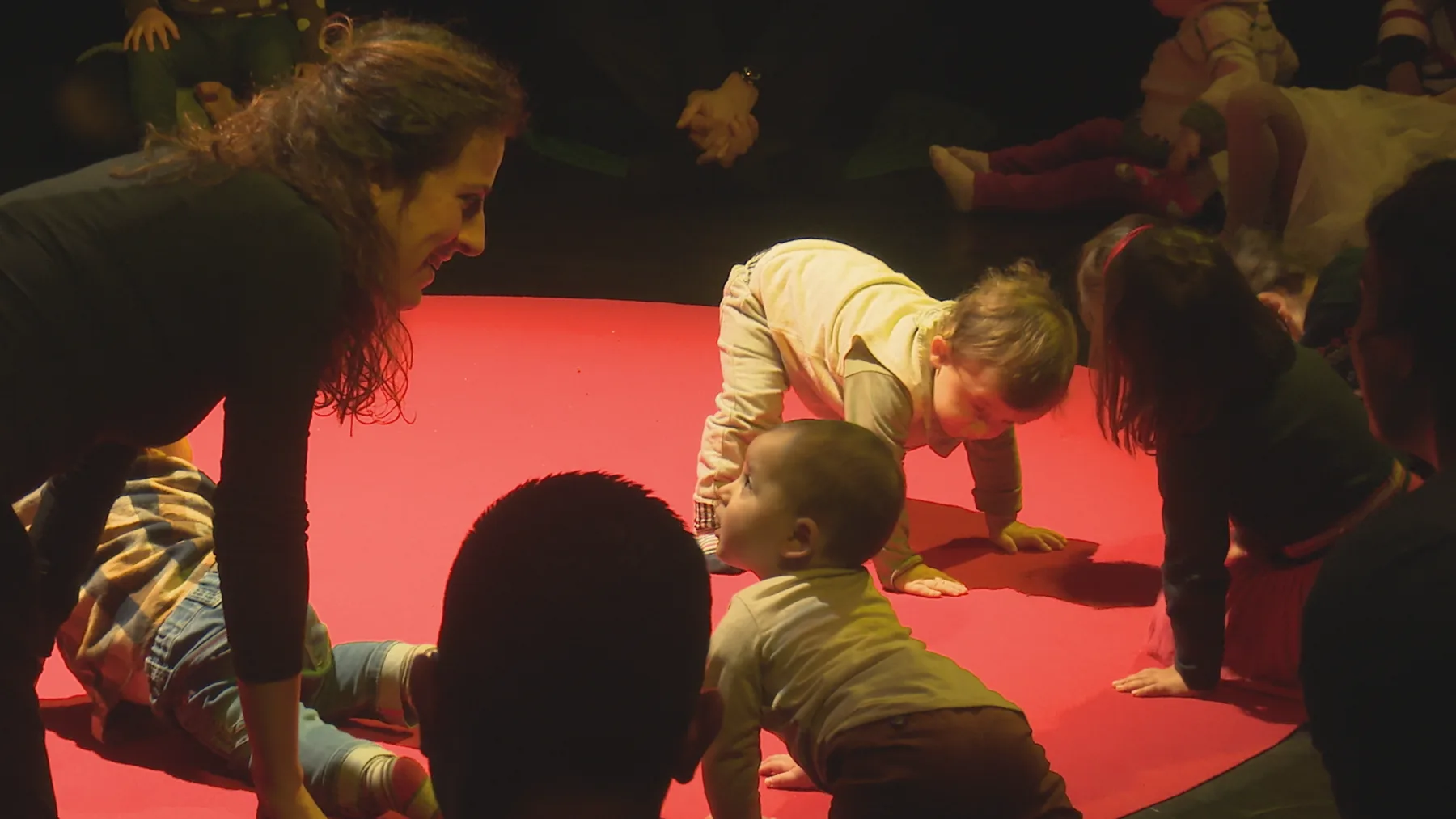
In this perspective, listening involves the whole body. Voice, breath, posture, gesture, movement, gaze and distance all participate. Music happens between bodies sharing the same space and time.
Music Learning Theory: an artistic and compositional reference
Edwin E. Gordon’s Music Learning Theory is an important reference, together with the experience developed through its application. It contributes to the importance given to wordless singing, variety of repertoire, movement and the possibility of encountering music before verbal understanding is required.
Within MiniMiniature these elements are transformed artistically. Knowledge about musical learning acts mainly as compositional competence: it encourages an essential use of words, leaves time for repetition and recognition, and helps shape repertoire, timing and modes of relationship.
The project brings together different musical materials, including music by Johann Sebastian Bach and Edwin E. Gordon as well as original compositions by Arnolfo Borsacchi. This variety belongs to the musical experience itself and broadens the ways audiences can encounter different forms, characters and organisations of sound.
Many forms of participation
MiniMiniature welcomes many forms of participation. The performers build conditions in which something can happen: a child may listen, move, vocalise, watch, seek the adult or explore the space. The response can emerge freely during the experience.
The accompanying adult can also share the listening with an attentive, participatory presence. Child and adult can inhabit an aesthetic experience together.