MiniMiniature debuted in 2019 at Teatro BuonaLaPrima in Buggiano. By July 2026 the project had reached 105 performances in Italy, Switzerland and Germany, meeting children and adults in theatres, museums, festivals, libraries, nurseries and schools.
A form able to inhabit different places
Since 2021, MiniMiniature has been presented on several occasions within educational initiatives of the Education Department of the Uffizi Galleries in Florence. Between 2021 and 2023 it also completed three tours for ERT Friuli-Venezia Giulia, reaching nurseries and preschools.
Over the years the project has appeared, among other places, at Teatro di Antella, Centro Sfera Bianca in Lugano, Biblioteca Delfini in Modena, Kultur Palast in Hamburg, the Un Prato di Libri festival and Biblioteca San Giorgio in Pistoia.
Theatres, museum galleries, libraries and educational spaces create different conditions of distance, movement, acoustics and audience configuration. Moving through them has helped the project understand which elements can adapt and which must remain constant for MiniMiniature to preserve its identity.
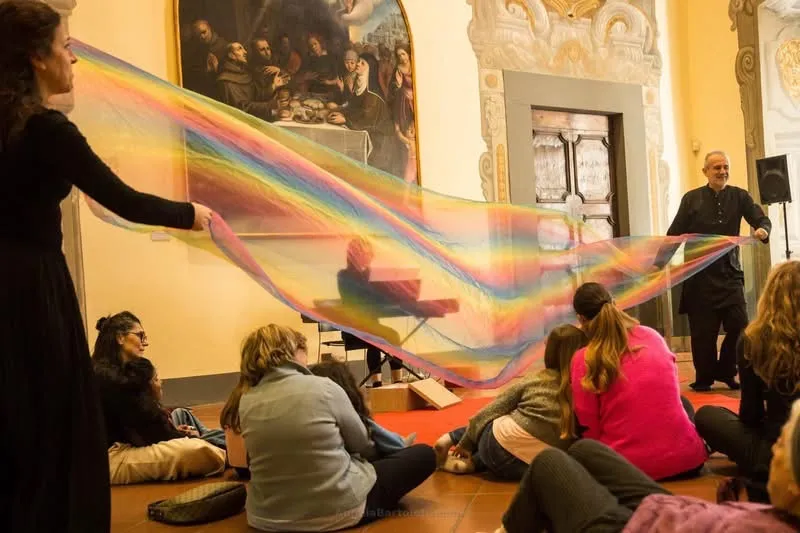
Three musicians, one shared construction
Arnolfo Borsacchi
Artistic direction, original compositions, texts and voice. A musician, composer and music educator, he has developed long-term work around listening, voice, movement and relationship with children. In MiniMiniature he shapes the overall artistic construction and performs as one of the two voices.
Pier Elisa Campus
Voice and co-founder of the project. Together with Arnolfo Borsacchi she is also part of the still-active Quarteto Gordon, an important shared path in their work on two voices, reciprocal listening and singing for early childhood.
Maddalena Bonechi
Pianist and teacher of Music History. In MiniMiniature, the piano defines harmonic and temporal spaces, supports transformations, connects different moments and can directly take responsibility for listening, as in the gradual gathering inward of the ending.
The trio is both MiniMiniature’s performing ensemble and the human and musical space in which its form is rebuilt each time.
A construction that stays alive
The two voices take on fluid functions. They may move together, separate, answer one another and carry different weight in different scenes. Voice, piano, gesture, movement and stage time belong to the same process.
In a performance based on proximity, this requires precision and enough mutual knowledge to change the duration, intensity or direction of a moment while keeping the overall structure clear.
The music includes works by Johann Sebastian Bach and Edwin E. Gordon alongside original compositions by Arnolfo Borsacchi; the original texts are by Arnolfo Borsacchi.